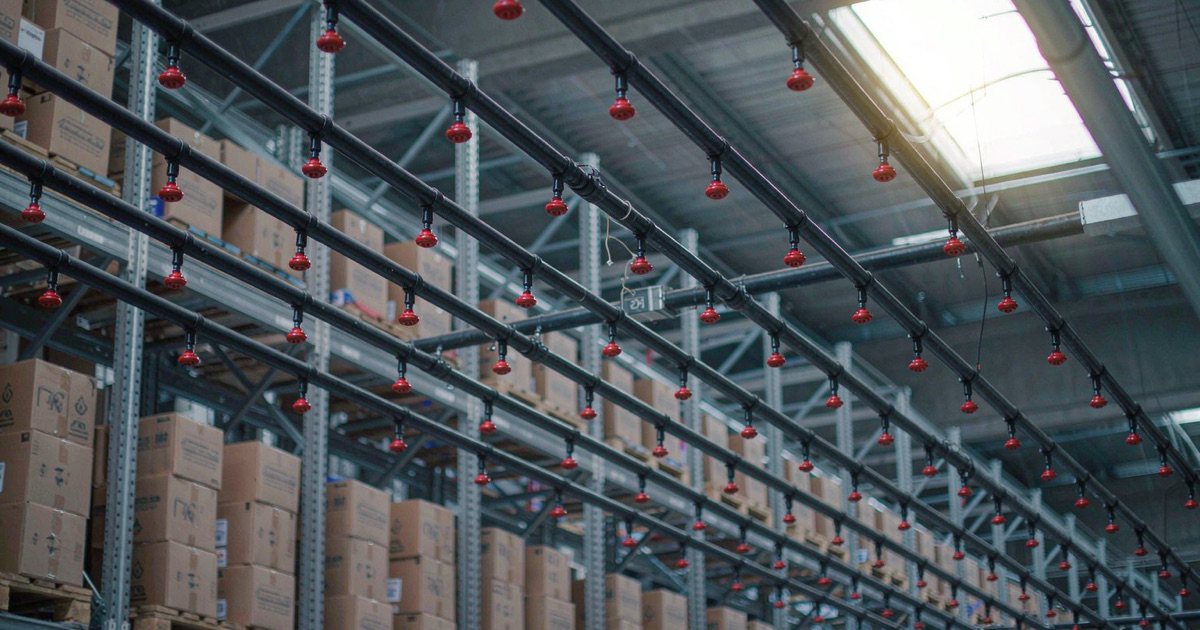
Aerosols do not stop being Class 2.1 dangerous goods once they leave the port. In most markets, stacking pallets of aerosol stock in an ordinary warehouse triggers fire-code obligations: sprinkler design, quantity limits, segregation and temperature control all apply before a single can is shipped to a customer. This guide explains which rules govern storage, what warehouses actually check, and which documents your supplier owes you.
Why Storage Is Regulated at All
An aerosol can is a sealed pressure vessel holding product and propellant. That combination is why the same can ships under UN 1950 as a dangerous good: the propellant is usually LPG (propane, butane or a blend), which is flammable. Heat, crushing or fire exposure can rupture cans, and a single failing can project others off the rack. Regulators treat stored aerosols the same way they treat other flammable stock, and in most codes they treat them more strictly, because a burning aerosol can behaves like a small projectile.
Two practical consequences follow. First, the rules that applied to your shipment apply to your stock — classification does not end at delivery. Second, the paperwork you received at export, especially the Safety Data Sheet, is the document your warehouse operator and local fire authority will ask for.
Who Regulates Aerosol Storage, Market by Market
| Market | Key rules for stored aerosols | Who enforces |
|---|---|---|
| United States | NFPA 30B (aerosol storage), OSHA 1910.106, International Fire Code | Local fire marshal / AHJ, OSHA for workplaces |
| United Kingdom | DSEAR 2002, national fire safety guidance | Local fire and rescue authority, HSE |
| European Union | No single EU storage code — national fire codes implement the duties; SEVESO thresholds apply only at large quantities | National and municipal authorities |
| Middle East & Asia | Civil defense and fire codes vary by country; UAE and Saudi civil defense both treat aerosols as flammable stock | Civil defense / local fire authority |
In the US, NFPA 30B is the reference standard most warehouses are measured against. It grades aerosols into levels by heat output and burn behavior, and it scales sprinkler density, storage height and aisle requirements to how much aerosol stock you hold. The details are technical, but the principle is simple: the more aerosols on site, the more engineered the storage has to be.
What Warehouses Actually Check
A third-party logistics provider or distribution center will run through the same questions before accepting your stock. These are worth answering before they ask:
- Classification. Is the product Class 2.1, and is the Safety Data Sheet current? Section 14 of the SDS should show UN 1950.
- Quantity. How many cans, and what net weight? Above modest volumes, US warehouses move aerosols into dedicated storage areas or protected racking instead of general shelf space.
- Segregation. Aerosols must be kept away from oxidizers and other incompatible goods. Most codes also require separation from ignition sources.
- Temperature. Standard carton markings in the US warn against storage above 120°F (49°C). Racks under an uninsulated roof in a hot climate can exceed that in summer, so temperature comes up in almost every warehouse audit.
- Sprinklers and racking. In-sprinklered buildings, protected racking, maximum stack heights and aisle widths — all defined by NFPA 30B and the local fire code.
- Signage and access. Placarding for flammable goods, clear aisles, and no-go stacking in front of exits.
The Documents That Come From the Supplier Side
Storage compliance splits into two halves, and importers sometimes assume their factory covers all of it. It does not. The supplier is responsible for documentation that describes the product correctly; the warehouse obligations attach to whoever holds the stock — usually you, the importer or brand owner.
From the supplier side, what you should be able to request is:
- SDS for the finished product, with Section 14 showing UN 1950, Class 2.1 and the correct packing group notation where applicable
- UN certification paperwork for the packaging used, if the cartons are certified for transport
- Carton markings: Class 2.1 diamond, UN number, and handle-with-care orientation arrows
- Aerosol can test documentation where your market requires it — drop tests, pressure and leak test records
What a supplier like us does not do: we are not a warehouse operator and we do not certify your storage site. If your 3PL asks for a "storage certificate," that is not a document a factory can issue — the certification that matters is your warehouse's compliance with its local fire code, verified by the local authority.
Common First-Time Mistakes
- Assuming general cargo rules. Some 3PLs accept aerosols; many others will not touch them without DG-trained staff and a sprinklered zone. Confirm before you book, not after the container lands.
- Losing count of net weight. Fire-code thresholds are set in net weight, not pallets. A container of 250 ml air fresheners and a container of 600 ml industrial cleaner sit in very different territory.
- Ignoring summer heat. Stock staged in a metal annex or trailer can pass 120°F in direct sun. Heat-driven can failures in storage are among the most common aerosol incidents, and they are entirely preventable with placement.
- No SDS on file at the warehouse. Fire marshals ask for it during inspections. Keep the SDS for every SKU with the warehouse operator — a copy in your email archive does not satisfy an inspector.
How Long Can Aerosol Stock Sit in a Warehouse?
Check the printed date on the can first: most finished aerosols carry a best-use window of roughly two to three years from production. The can does not spoil like food, but propellant slowly permeates through valve gaskets and seams, so pressure and spray pattern degrade on old stock. Rotate first-in-first-out, avoid holding a full container plus a half container of the same SKU, and if stock has sat through more than one summer in a hot building, have a few cans test-sprayed before shipping to customers. For importers planning promotional volumes, this is also an argument for ordering against real demand rather than filling a warehouse.
What to Ask a 3PL Before Your First Aerosol Container
If you are handing stock to a third-party logistics provider for the first time, five questions separate a warehouse that can hold aerosols from one that will discover the problem when your container is already at the port:
- "Are you set up for Class 2.1 stock, and what is your per-pallet surcharge for it?" DG-capable 3PLs quote this routinely; hesitation is your answer.
- "What is the maximum quantity of aerosols I can hold under your current fire permit?" Permits are issued per site and per quantity class. If your reorders will double your stock, ask now whether the permit has headroom.
- "Do you store aerosols in dedicated racking or general space?" General space is workable at small volumes; pallet volumes need the protected racking NFPA 30B describes.
- "How do you handle SDS filings and fire-marshal inspections?" A capable operator asks you for the SDS before you offer it.
- "What happens if a can fails on the rack?" Look for a spill and isolation procedure, not improvisation. This is also a fair question for any warehouse holding your stock long term.
A Quick Setup Checklist
- SDS on file with the warehouse for every aerosol SKU
- Storage zone away from oxidizers, ignition sources and direct sunlight
- Ambient temperature managed below 120°F (49°C) — insulated space or climate control in hot climates
- Racking and stack heights confirmed against NFPA 30B or your local equivalent
- Flammable-goods signage posted and aisles kept clear
- Staff briefed on what a hissing or bulging can means and how to respond
Frequently Asked Questions
Do aerosols count as dangerous goods in storage, or only in transport?
In storage too. Transport rules like ADR and IMDG end at delivery, but fire codes govern storage continuously. In the US that means NFPA 30B and the local fire code; in the UK, DSEAR; elsewhere, national fire regulation. The classification that made the can shippable as UN 1950 is the same one that puts it in a regulated storage category.
What temperature can aerosols be stored at?
Standard US carton markings warn against storage above 120°F (49°C). Cool, dry and out of direct sunlight is the practical rule; heat is the main failure trigger, and repeated hot-cold cycles also stress valves and seams over long holding periods.
How many aerosols can I store without special requirements?
It depends on the market and the product's NFPA level, so there is no single number. Small retail quantities in a sprinklered store room are treated leniently; pallet volumes in a warehouse usually require protected storage areas and engineered sprinklers. Your local fire authority or a DG-experienced 3PL can confirm the threshold that applies to your quantity and building.
Who is responsible for storage compliance — the factory or the importer?
The party holding the stock. The factory's duty ends with accurate documents (SDS, UN packaging certification, correct markings). Once the goods are in your warehouse or your 3PL's, the fire-code obligations attach to that site and its operator. That is why the SDS handover matters: it is the document that connects your product to the rules your warehouse must follow.
Storage is the last leg of the aerosol supply chain, and it runs on the same paperwork as the first leg. If you are planning US or EU stockholding, request the UN packaging certification and the full compliance document set for your SKUs before the container sails. For the transit side, see our guides to IMDG ocean freight and dangerous goods shipping — and our quality documentation overview lists every certificate and test file we keep on request.