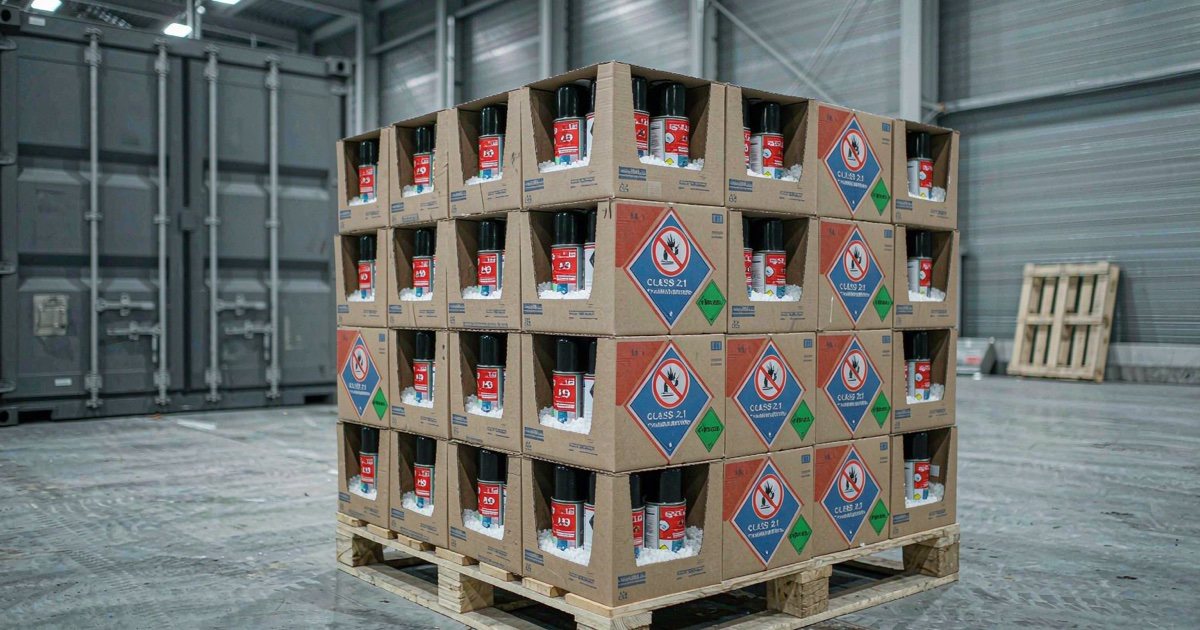
Last March, a São Paulo automotive care distributor took delivery of a 20-foot container packed with carburetor cleaner, brake dust remover, and dashboard spray. The goods had left Ningbo on time, cleared Chinese customs without a flag, and looked fine when the seal was cut. Then the local freight agent asked one question: "Where is the batch test certificate for the UN 1950 classification?" The buyer's folder had the commercial invoice, the packing list, the bill of lading, even a glossy certificate from a third-party lab. But nobody had issued a certificate tied to the actual production lot, valve type, and propellant mix on that specific sailing.
The container sat at Santos for nine days. Demurrage, detention, forwarding re-work, and a rushed local inspection added $8,400 to a $34,000 order. The products were not mislabeled. The cans were not leaking. The paperwork was simply one layer too thin for dangerous goods aerosol shipping.
That story is more common than most buyers expect in dangerous goods aerosol shipping. In dangerous goods aerosol shipping, aerosols are Class 2.1 under UN 1950 — "Aerosols, flammable" — and every mode of transport treats them differently. Ocean freight asks for one set of documents. Road freight in Europe asks for another. Air freight asks for the most. If your supplier hands you a generic SDS and calls it done, you are one customs clerk's question away from the same nine-day hold.
This guide walks through what dangerous goods aerosol shipping actually requires, where buyers get caught, and how to build a document pack that moves through ports instead of sitting beside them.
The Real Difference Between "Packed Properly" and "Shipped Legally"
A pallet ready for dangerous goods aerosol shipping can look perfect: upright cartons, fragile labels, UN marks on the cans. That does not mean it is ready to sail. Dangerous goods aerosol shipping has three separate gates:
- Classification. Every SKU needs a proper shipping name, UN number, class, and packing group where applicable. Most flammable aerosols fall under UN 1950, Class 2.1, with no packing group. But the details matter: flammable versus non-flammable, limited quantity versus full dangerous goods, and net quantity per can.
- Packaging compliance. The cans themselves are the inner receptacles. Outer cartons must pass the tests required by the packing instruction — drop test, stacking test, and leakproofness where applicable. UN-certified outer packaging carries a UN mark like 4G/Y/S/yy or 4GV/Y/S/yy.
- Documentation and marking. Shipping papers, dangerous goods declaration, limited quantity marking or full DG labels, emergency contact, and often a batch test certificate showing the lot passed the relevant tests.
A supplier who fills cans in a clean room and ships them in strong cartons may pass the first gate and fail the second or third. That is exactly what happened in São Paulo. The cans were fine. The classification paperwork was generic and not lot-linked.
Why UN 1950 Is Just the Starting Point
UN 1950 covers "Aerosols, flammable," with each receptacle not exceeding 1,000 ml of capacity. In practice, most consumer and industrial aerosols are under 750 ml, so they fit. But the same UN number does not mean the same handling rules in dangerous goods aerosol shipping.
Under the IMDG Code, aerosols can often move as limited quantity if the net contents per can do not exceed 1 L and the gross mass per package does not exceed 30 kg. Limited quantity shipments get reduced marking: a diamond with black hatch marks on a white or contrasting background, plus the UN number and proper shipping name. They do not always need a full dangerous goods declaration, but they still need a declaration that the goods are described and packed according to the limited quantity provisions.
The U.S. DOT takes a slightly different path. 49 CFR 173.306 allows small aerosols to move under exceptions if they meet pressure, capacity, and packaging limits. The EPA and PHMSA both note that transport rules are layered on top of product rules: a can may be EPA-compliant for formulation and DOT-compliant for shipment, but the two approvals do not replace each other.
For European road transport, ADR applies. Aerosols move under packing instruction P207 or LP200 depending on the configuration. The driver must carry the dangerous goods transport document, and the vehicle may need orange plates if the total quantity exceeds certain thresholds.
Air freight is the strictest. IATA DGR Section 2.3 and Packing Instruction 203Y or 203 apply. Most flammable aerosols are forbidden on passenger aircraft and restricted on cargo aircraft. Lead times for air DG bookings are longer, and not every airport handles aerosols.
The point is simple: dangerous goods aerosol shipping is not one rule. It is a set of mode-specific rules built on the same UN classification.
What the São Paulo Buyer Should Have Asked For
After the delay, the distributor and the supplier rebuilt their dangerous goods aerosol shipping checklist. It now covers four document groups before any container is sealed.
1. Lot-linked batch test certificate
A batch test certificate proves the production lot passed the tests required by the packing instruction. For aerosols, that usually includes:
- Internal pressure test at 50°C or 55°C, depending on the regulation.
- Leak test before packing.
- Compatibility between the formulation and the internal coating (epoxy-phenolic lining is common for solvent-based products).
- Valve gasket compatibility, especially for products with strong solvents — a paint stripper is the extreme end of that scale — or DME propellant.
The certificate must reference the batch number on the cans, not just a generic product code. A lab report from six months ago for a different propellant blend is not enough.
2. Dangerous goods declaration matched to the transport mode
In dangerous goods aerosol shipping, the declaration must match the actual mode:
- Sea: IMDG Code dangerous goods declaration, or a limited quantity declaration if applicable.
- Road (Europe): ADR transport document with proper UN number, class, packing group, and total quantity.
- Air: IATA Shipper's Declaration for Dangerous Goods, plus an air waybill note.
- Road (U.S.): Bill of lading with proper shipping name, hazard class, UN number, and packing group.
A single template with blanks to tick "sea/air/road" is a red flag. Each mode has different fields.
3. Packaging compliance record
For dangerous goods aerosol shipping, the supplier should keep records of the UN performance test for the outer packaging. For aerosols, common outers are 4G fiberboard boxes or 4GV combination boxes. The mark tells you the box passed tests for specific inner receptacles and gross mass. If your cans are taller or heavier than what the box was tested with, the mark does not cover you.
4. Emergency response information
Most regulations require a 24-hour emergency contact and product-specific guidance. A generic SDS phone number may not satisfy a customs officer who wants to know what to do if a can ruptures.
A Practical Comparison: Limited Quantity vs. Full Dangerous Goods
| Factor | Limited Quantity (LQ) | Full Dangerous Goods |
|---|---|---|
| Typical inner limit | Up to 1 L net per aerosol can | Same can size, but full DG rules apply |
| Outer package gross mass | Usually ≤ 30 kg | No fixed cap; follows packing instruction |
| Marking | LQ diamond + UN number | Full Class 2.1 flammable gas labels |
| Declaration | Simplified LQ declaration | Full dangerous goods declaration |
| Carrier acceptance | Easier; more liner options | Restricted; fewer carriers; surcharges |
| Documentation load | Light | Heavy: test certs, packing cert, emergency info |
| Best fit | Consumer-size cans, mixed SKU pallets | Large single-SKU volumes, air freight, stricter markets |
Most Midwel dangerous goods aerosol shipping to distributors moves under limited quantity because the typical order mixes 450 ml brake cleaner, 500 ml dashboard shine, and 600 ml carburetor spray in one container. The buyer saves on carrier surcharges and documentation, but only if the cartons are marked correctly and the lot-linked certificate for dangerous goods aerosol shipping is on file.
Midwel's Dangerous Goods Aerosol Shipping Setup
At Midwel, dangerous goods aerosol shipping is not an afterthought bolted onto standard production. The factory runs an integrated line: can forming, internal coating, valve insertion, gassing, crimping, leak detection in a hot bath, weight check, and batch coding. That integration matters because the batch number stamped on each can links back to the exact propellant load, valve type, and formulation tested for that lot.
Here is what that means for dangerous goods aerosol shipping compliance:
- Every production batch gets a test certificate. Pressure, leak, and compatibility records are tied to the batch code printed on the can. When a buyer's freight forwarder asks for lot-linked paperwork, we pull the matching certificate instead of a generic product report.
- UN-certified packaging is sourced and tested as a system. Cans, dividers, and outer cartons are qualified together, not thrown together at the warehouse door. The outer box carries the correct UN mark for the can sizes and gross mass in that shipment.
- Multi-mode documentation. We prepare IMDG declarations for sea freight, ADR documents for European road delivery, and 49 CFR-compliant paperwork for U.S. imports. Air freight bookings get IATA DGR-compliant shipper's declarations when the product and route allow.
- Third-party inspection on request. For buyers who want an extra layer, we arrange pre-shipment inspection by independent labs for pressure retention, fill weight, actuator spray pattern, and carton drop tests.
- Door-to-door coordination. Our export team handles the Chinese side: dangerous goods packaging certificate, commodity inspection, customs declaration, and booking with carriers experienced in Class 2.1 cargo. That is the difference between a factory that "can ship DG" and one that ships DG every week.
Our dangerous goods aerosol shipping experience covers the same markets where our products already sell: Saudi Arabia under SASO requirements, Germany under REACH and CLP, Brazil under ANVISA and customs rules, and the United States under DOT and EPA. The compliance pack for dangerous goods aerosol shipping is adjusted for the destination, not copy-pasted from the last order.
Three Mistakes That Delay Containers
Even experienced buyers slip on the small print of dangerous goods aerosol shipping. Here are the three we see most often.
Mistake 1: Using one SDS for classification. The Safety Data Sheet describes the product hazard for workplace use. The transport classification describes how the product must move. They are related but not identical. A product with a low flash point may need a different handling code than one with a higher flash point, even if the SDS looks similar.
Mistake 2: Forgetting the valve changes the classification. A standard 1-inch valve, a 360-degree valve, and a foam actuator can change how the aerosol performs in testing. If you change the valve to target a new application — say, a foam valve for an industrial degreaser — the batch test certificate must reflect that change.
Mistake 3: Assuming the forwarder handles everything. A forwarder moves boxes. They are not responsible for the accuracy of your batch test certificate or the validity of your UN box mark. The supplier and buyer share that responsibility. The cheapest shipping quote is expensive if the container spends a week in detention.
Frequently Asked Questions
What documents does dangerous goods aerosol shipping require?
For dangerous goods aerosol shipping, you need at minimum: commercial invoice, packing list, bill of lading or air waybill, dangerous goods declaration matched to the transport mode, lot-linked batch test certificate, and packaging compliance record. Some destinations also require a dangerous goods packaging certificate from the issuing country and an SDS translated into the local language.
Can aerosols ship as limited quantity by sea?
Yes, in most cases. Under the IMDG Code, flammable aerosols up to 1 L net per can and 30 kg gross per outer package can move under limited quantity provisions. The outer package must carry the limited quantity mark, and the shipper must declare that the consignment meets those provisions.
How long does dangerous goods aerosol shipping take compared to normal cargo?
Booking lead time is usually 3 to 7 days longer because fewer carriers accept Class 2.1 cargo and slot approvals take time. Ocean transit itself is the same. Road and air are more restrictive: some routes require dedicated vehicles or cargo-only aircraft, which can add several days.
Does changing the propellant affect shipping classification?
It can. LPG-based propellants are common and well-documented, but blends with DME or compressed air may shift pressure and flammability characteristics. Each production batch must be tested against the classification and packaging used for that shipment, not against an old certificate.
What should I ask a supplier before placing a dangerous goods aerosol order?
Ask for: a sample batch test certificate, the UN mark on the outer packaging, a draft dangerous goods declaration for your chosen transport mode, and references for DG shipments to your destination country. If the supplier hesitates on any of those, treat it as a warning sign.
Conclusion: Make Compliance Part of the Quote
Dangerous goods aerosol shipping is not a surprise that appears after production. It should be built into the first quote: the right can, the right valve, the right propellant, the right box, and the right document pack for the destination and transport mode. Buyers who treat shipping as a logistics detail often learn the hard way that it is a product detail.
If you are planning dangerous goods aerosol shipping and want to know whether your SKU set should move as limited quantity or full dangerous goods, get a free quote and we will review the classification, packaging, and paperwork before production starts. For buyers who want to test the product and the documentation process first, request a sample with a draft dangerous goods declaration included.
Headed to the United States after the goods clear the port? Our guide to US import rules for aerosols covers the FDA, EPA and CPSC split.
The journey does not end at the port. Once goods reach their destination, warehouse storage rules for aerosols take over.