TL;DR
In short: Six weeks from brief to shelf is achievable on an OEM aerosol insecticide, but only when three things are already done: the formula is locked with a third-party lab, the artwork is print-ready, and the active-ingredient registration was submitted months earlier.
- Week 1 — compatibility and sample fill: Testing between your concentrate and the can lining runs for three days; the pilot fill runs about 60 cans, crimped at 180 psi with an LPG charge of 35%, then water-bath tested and sprayed for pattern and output rate.
- Week 2 — evaluation and spec lock: Two change requests came back on this programme: fragrance load from 0.4% to 0.6%, and a swap to a 360° valve. Both were settled by day 13 and signed into a four-page master spec sheet.
- Week 3 — mass production: 48,000 cans in 300 ml format across two shifts in five days. The hold-and-release rate was 1.4% against an AQL 1.5 threshold.
- Week 4 — documents: Insecticides are UN 1950 Class 2 dangerous goods. The SDS, GHS label and dangerous goods declaration were ready on day 22.
- What breaks the six weeks: An unlocked formula, artwork that is not print-ready, or a pesticide registration that has not been filed. None of the three can be compressed into the calendar, and each one costs weeks rather than days.
A buyer emailed us in early March with a sealed bottle of a competitor's insecticide and a single sentence: "We need this on our shelves by mid-April, in our brand, in a 300ml can, with a kill-claim on mosquitoes and houseflies. Can you do six weeks?"
That brief is not unusual — it is roughly what most buyers ask for, and it is roughly what most buyers cannot be given. Six weeks is achievable on an OEM aerosol insecticide spray, but only when three preconditions are already in place before the project starts.
The honest answer was yes, but only because his formula was locked with a third-party lab, his artwork was print-ready, and his registration for the active ingredient (transfluthrin 0.10%) had already been submitted six months earlier. Without any one of those, six weeks would have been fiction.
What follows is what happened on that project, week by week — the brief, the schedule it produced, and the three preconditions that decide whether your own project runs in six weeks or sixteen. It also covers what buyers consistently get wrong about OEM aerosol insecticide manufacturing that no sales rep tells them up front.
The Brief That Made Six Weeks Possible
Most aerosol insecticide projects fail the schedule test for one of three reasons: the buyer assumes "OEM" means the factory develops the formula (it usually does not — most OEM programs start with the buyer's formula), the buyer assumes registration is included (it almost never is), or the buyer assumes artwork design is the factory's job (again, almost never).
The buyer had cleared all three. His brief, which arrived as a single PDF, contained:
- Active ingredient: transfluthrin 0.10%, plus PBO 0.50% synergist
- Fill weight: 300g ± 2g
- Propellant: LPG blend (propane/isobutane), 35% by weight
- Can: 65mm diameter tinplate, epoxy-phenolic inner coating
- Valve: standard V57 female valve, 0.41mm stem orifice, fine-mist actuator
- Packaging: 24 cans per UN-specification corrugated carton, 96 cartons per pallet
- Target market: Brazil (ANVISA registration number attached)
- Drop-test certificate: required before first shipment
When a brief arrives this complete, the project can move into sample production in under five business days. When it arrives incomplete — vague on active concentration, missing valve spec, no clear registration status — the project spends its first two weeks in clarification emails.
Week 1: Compatibility Testing and Sample Fill
The first three days went into compatibility testing between the buyer's concentrate and our standard tinplate can lining. Transfluthrin is generally stable in epoxy-phenolic linings, but the PBO synergist is more reactive — we have seen it slowly degrade certain gasket materials over accelerated stability testing. The lab ran a 50°C oven test on three candidate gasket compounds, with visual inspection at 7-day intervals. The EPDM gasket with PTFE coating passed.
Day 4 was the sample fill: 60 cans on the pilot line, 0.41mm stem V57 valve, manual crimping at 180 psi, LPG charge at 35%. Cans were water-bath leak-tested at 50°C for three minutes, then left at room temperature for 24 hours before spray-pattern and output-rate testing.
On Day 5 the samples shipped by courier from the factory. Total sample cost: USD 280. The sample fee is waived for OEM programs with confirmed purchase intent, but this buyer insisted on paying it to keep the project commercial.
Week 2: Buyer Evaluation and Specification Lock
The samples landed in seven days. The buyer tested them against the competitor's product on three metrics: spray pattern (cone angle measured at 20cm distance), knockdown time on free-flying houseflies (industry-standard Peet-Grady chamber method), and 30-day scent stability (no off-odors from the propellant breaking down the fragrance).
He came back with two change requests: increase the fragrance load from 0.4% to 0.6% to mask the LPG smell in enclosed rooms, and swap the actuator from a standard fine-mist to a 360° valve that sprays in any orientation. Both changes are routine. The fragrance adjustment was made in lab on Day 11 and the valve change was a stock-item swap on the filling line.
By Day 13 the specification was locked. Both parties signed a master spec sheet — a 4-page document covering every variable from active concentration to carton printing color. This is the document the production line works from for the next 25 years of reorder campaigns. Get it right once.
Week 3: Mass Production and In-Process Quality Control
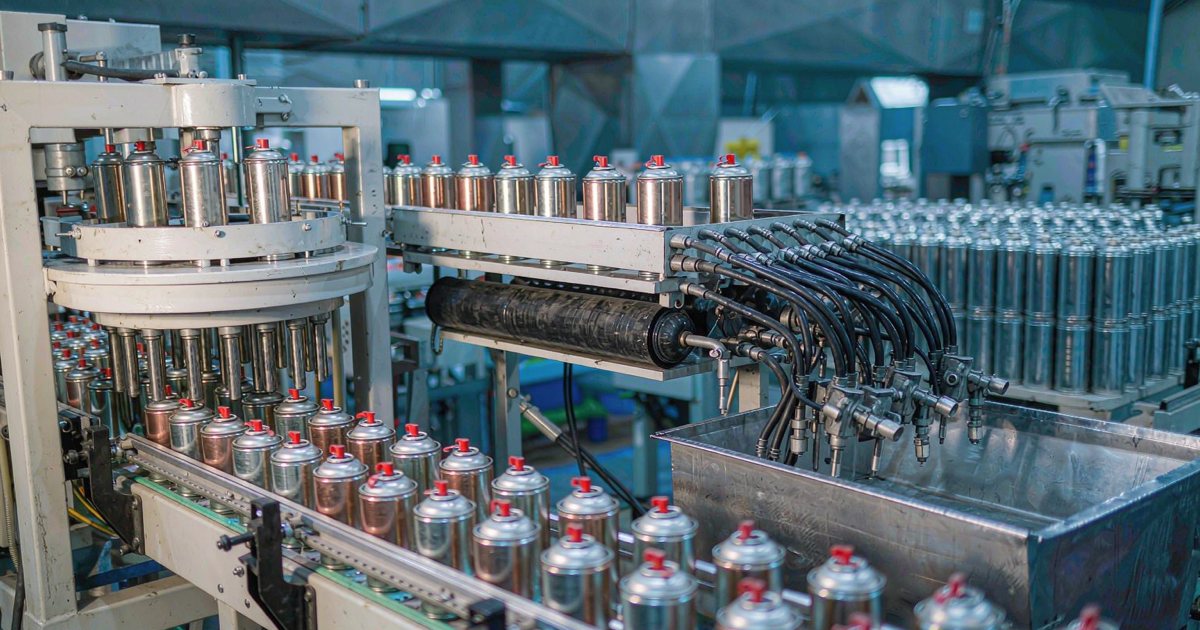
Mass production ran across two shifts for five days, producing 48,000 cans in 300ml format. The line ran at 95 cans per minute with the following in-process checks:
| QC Checkpoint | Frequency | Action on Failure |
|---|---|---|
| Fill weight | Every 30 minutes, 5 cans | Stop line, recalibrate filling nozzle |
| Crimping pressure | Every 2 hours, 10 cans | Adjust crimper die, retest |
| Water-bath leak test | 100% of cans | Reject and quarantine any leaker |
| Valve actuation force | Every 4 hours | Reject batches outside 35–55N range |
| Propellant charge | Continuous, by weight | Reject underfilled cans |
| Visual / label print | AQL 1.5 sampling | Hold and inspect full batch |
Three batches were held for further inspection: one for a marginal underfill on the first 200 cans (operator error on the filler's volumetric piston), one for a label alignment issue affecting 480 cans (the label applicator's sensor was dirty), and one for a single leaker detected in the water bath (the leaker's valve gasket had a manufacturing defect from the supplier).
All three were resolved within 24 hours. The hold-and-release rate on this run was 1.4% of total production — well within the AQL 1.5 threshold.
External Reference: According to the U.S. EPA's aerosol product testing guidance, each registered insecticide formulation must be tested under the actual can, valve, and propellant configuration used in production — not in glassware or surrogate containers. The compatibility testing described above is the minimum required for label claims to remain valid.
Week 4: UN Drop Testing and Export Documentation
Insecticides are UN 1950 Class 2 dangerous goods. Every export batch requires:
- UN drop test certificate — performed on the actual can, valve, and propellant configuration, signed by an accredited third-party lab
- Safety Data Sheet (SDS) — 16-section document covering composition, first aid, fire-fighting measures, accidental release
- GHS label — the orange-bordered diamond with pictograms for flammability, health hazard, environmental hazard
- UN packaging certificate — for the outer carton, confirming it passes the 1.2m drop test at -18°C
- Dangerous goods declaration — for the freight forwarder
The drop test took three days because we sent samples to an external lab in Shanghai. The SDS and GHS label were drafted from the formula's existing documentation and finalized in two days. The dangerous goods declaration was prepared by our export team from the freight booking.
On Day 22, the documents were ready. The buyer received PDFs by email and originals by DHL.
Week 5: Palletizing, Container Loading, and Pre-Shipment Inspection
The 48,000 cans were palletized on standard 1200x1000mm wooden pallets, 96 cartons per pallet — 2,000 cartons across 21 pallets. Each pallet was stretch-wrapped, corner-protected, and labeled with the buyer's SKU, batch number, and ANVISA registration code.
The buyer had hired a third-party inspection agency to perform the pre-shipment inspection on Day 27. The inspector pulled 200 cans from 20 randomly selected cartons across 5 pallets and verified fill weight, label accuracy, valve actuation, and visual defects. Zero failures.
The container — a 40-foot high cube — was loaded at the factory on Day 28. He had the option of FOB Shanghai or CIF to the destination port, and chose CIF for the first order; we would expect him to switch to FOB on the reorder once he has his own forwarder. Total volume: 21 pallets, 22,000 kg gross weight, 48 CBM.
Week 6: Sea Transit, Customs Clearance, and Shelf Delivery
The container left Shanghai on Day 30, transited Singapore and Santos, and arrived at the buyer's warehouse on Day 41 (11 days sea transit, customs clearance, and inland trucking included). The buyer paid the deposit on Day 1, paid the balance against a copy of the bill of lading on Day 32, and had product on shelves by Day 45.
Six weeks from email to shelf, give or take three days for sea transit scheduling.
What This Project Taught Us About OEM Aerosol Insecticide Spray Timelines
Six weeks is not a marketing promise. It is the realistic floor when five conditions hold:
1. The formula is already developed and registered in the target market, ideally with a third-party lab, not the OEM manufacturer. A factory that promises to develop a new active ingredient, register it, and ship it in six weeks is overselling.
2. The buyer knows what valve, actuator, and propellant system they want, or is willing to accept the factory's recommendation within 48 hours.
3. The artwork is print-ready before the project starts — not a "we'll get to it next week" file.
4. The buyer has confirmed a freight booking and dangerous goods declaration timeline with their forwarder, not waiting for the factory to recommend one.
5. The buyer understands that pre-shipment inspection costs are theirs, not the factory's, and that the inspection should be scheduled before container loading, not after.
When any one of these is missing, the project timeline stretches by 7–14 days. When three or more are missing, the project usually needs 90–120 days from brief to shelf — and the buyer's launch date has to move.
How Midwel Runs OEM Aerosol Insecticide Projects
Our manufacturing partner's plant covers 98,796 m² and runs dedicated filling lines for insecticide spray, kept separate from personal-care and household lines. This separation matters: insecticide formulations carry solvent and active residues that would contaminate fragrance products, so cross-contamination is a non-starter for buyers whose end products require fragrance clarity.
For OEM insecticide projects, our standard operating procedure follows the same six-week template above, scaled to the buyer's volume:
- MOQ: 20,000 units per SKU, with multi-SKU pilot orders available for buyers testing multiple variants
- Sample timeline: 7–15 days from confirmed brief to delivered samples
- Mass production: 15–20 days depending on order volume and active ingredient availability
- Export documentation: UN 1950 dangerous goods package, ANVISA / EPA / EU registration support, original drop test certificates
- Compliance certifications: ISO 9001, ISO 14001, UN, CE, DOT, RoHS, SASO, REACH — covering the documentation your OEM aerosol insecticide spray launch needs to clear customs on first attempt.
Our automotive care, household, and industrial maintenance lines share the same export framework — UN packaging, dangerous goods declarations, third-party drop testing — because all aerosols are Class 2 dangerous goods regardless of end use. For buyers whose OEM aerosol insecticide spray development cycle is shorter than their registration timeline, we help plan the documentation handoff so production and registration run in parallel rather than in series.
The Honest Answer to "Can You Do Six Weeks?"
Yes — when the five conditions above hold. No — when any one of them is missing, in which case the project timeline should be planned for 90–120 days and the buyer's launch date should be set accordingly.
The fastest way to test whether your project can fit a six-week timeline: send the OEM factory your complete brief — formula, artwork, registration status, target market — and ask for a week-by-week project plan before signing anything. A factory that gives you a real timeline within 48 hours is one that has run these projects before. A factory that says "yes, no problem, six weeks, easy" without asking for the brief is one that has not. For brands considering an OEM aerosol insecticide spray launch in the next quarter, the upfront work on formula, artwork, and registration is the real lever — and the factory's job is to fill the remaining weeks, not to invent them.
FAQ: OEM Insecticide Timelines
How quickly can an OEM aerosol insecticide spray project go from brief to shipment?
When the formula is pre-registered and the artwork is print-ready, six weeks is achievable: 5 days for compatibility testing and sample fill, 8 days for buyer evaluation and spec lock, 12 days for mass production, 5 days for export documentation and pre-shipment inspection, 11 days for sea transit. Add 30–60 days if active ingredient registration is required in the target market.
Does the OEM factory handle active ingredient registration in the target country?
No. Registration is the buyer's responsibility, with the factory providing SDS, formulation data, and certificate of analysis. For the Brazilian market this is ANVISA; for the U.S. it is EPA; for the EU it is REACH plus national poison center notification (PCN). A factory that claims to "handle registration" is usually either misdescribing their service or charging a markup on a third-party consultant.
What is the minimum order quantity for a private label insecticide spray?
Midwel's standard MOQ for OEM insecticide projects is 20,000 units per SKU. Multi-SKU launches (for example, two scent variants at 10,000 units each, or three SKUs at about 6,600 units each) can be combined within a single production run for market-validation purposes. Below 20,000 units, the unit cost rises significantly because line changeover costs are spread across fewer cans.
What propellant options are available for OEM insecticide formulations?
LPG blends (propane/isobutane) remain the most common propellant for household insecticides because of low cost and consistent spray pressure. DME (dimethyl ether) is water-miscible and enables water-based insecticide formulations, but requires different valve gaskets due to higher solvent activity. Compressed air and nitrogen are VOC-free alternatives but require specialized valves and typically produce softer spray patterns. The choice depends on the active ingredient, target spray character, and VOC regulations in the destination market.
Can I ship insecticide aerosols to any country without restrictions?
No. Aerosol insecticides are UN 1950 Class 2 dangerous goods worldwide and require UN packaging certification, dangerous goods declarations, and (for air freight) IATA-compliant labeling and quantity limits. Some countries also require pre-shipment notification (for example, the U.S. EPA's 40 CFR § 156 subpart K) or specific product registration (for example, ANVISA in Brazil, Saudi Arabia's SFDA). The OEM factory can prepare the documents, but the regulatory compliance is the buyer's responsibility.
Ready to scope your OEM aerosol insecticide project?
- Get a Free Quote — share your formula, target market, and volume, and our team will return a week-by-week project plan within 48 hours.
- Request a Sample — see our filling quality, valve compatibility, and packaging finish before you commit to mass production.
---
Last updated: September 2026